Showing posts with label Garden lessons. Show all posts

Thursday, November 15, 2012

Trough of the Week: Jingle Troughs ~ Phase One


As I have laid to rest a solid stash of 3-season troughs, I turn my thoughts now to my holiday line. I call them "Jingle Troughs." I am preparing them for a Holiday Market I will be attending on Dec. 1.
Behold the be-decked Chamaecyparis obtusa 'Chirimen'! For now,  I am playing with the idea of having this unique miniature conifer be the only star in the Jingle-trough show, along with various holiday accoutrements that inevitably warm one's heart in the season. One of the two (above, left) is livened up with a cutting of Winterberry (Ilex verticillata), God's gift to gardeners during the winter. The other (below, right) is the tree, a rock, and some ACMoore specials. I'm still playing with various arrangements, so don't judge me yet. This attempt is Phase One: to be looked at by me for a few days and then expanded upon as my sensibilities dictate.

Back to some life lessons:

Aspiration: To make money selling these babies because I am broke.
Garden Lesson: So many versions of natural life play well with another to create an ambiance unmatched by plastic and glitter.
Life Lesson: Take pleasure in the simple, natural, beautiful gifts of earth which, by the way, don't cost a penny.

Friday, November 2, 2012

Good Night, Troughs

There is a time to plant and a time to cease from planting

The troughs are heeled in and covered with salt marsh hay, ready for winter. I know of some people who don't go to these lengths and swear it is not necessary. Others wouldn't go through a New England winter without imposing some defense against the cold, wet and wind.

Aspiration: To give these little worlds the best possible chance to survive a punishing season.

Garden Lesson: Conifers and hardy sedums are strong. But even the strongest need help against extreme conditions.

Life Lesson: There is a time to cultivate and encourage growth, and there is a time--after having done the best you can do humanly -- to stop.

Next Post: The Trough of the Week

Wednesday, October 24, 2012

Growing Tiny Gardens: Fourth Steps, and Onward

Keep in mind balance, a color palette, and room to grow.
Choosing Your Plants for Your Hypertufa Trough

After having broken ground in preliminary reconnaissance of the market (step one); having built up inventory (step two); having gotten comfortable handling and working with plants and figuring out their growing patterns, kind of (step three); the time has come to work with the dirt.

Choosing plants for the trough is like weaving a tapestry: you think about balance, color, compatibility and complementarity.

First thought: Is the trough going to be a full sun trough or a part shade trough?
Second thought: Is the trough going to stand alone or will it be part of a larger trough installation?
Third thought: How much growing room will the respective plants require (read: how to space the plants) and what are the depth requirements for the roots?

Even if you have not achieved 100 percent competence in these matters, put something in the dirt. It's time to let the plants do what they were made to do. Your job is to watch, tend, clip now and then, and try again if the trough is telling you it's not happy.

Keep in mind a few key principles:

~ Odd numbers of plants create a more natural-looking arrangement than even numbers.
~ Introduce into your trough a mixture of vertical growers, sprawling flow-ers, and creeping ground coverage (each of these categories will be addressed in upcoming posts).
~ Try to stick with a color pallet. For example, dark bluish-green conifers work well with pink-tinged sedums and gentle mossy thyme. Bright green conifers work with reds and lime-green grasses or herbs.

Think of the trough as your canvass and the plants as your palette.
This smaller trough contains a vertical Mexican
Feather Grass (Stipa tenuissima), a sprawling miniature
Cotoneaster 'Tom Thumb', and a low-growing
red sedum (Sedum rubrotinctum), which adds
a splash of color.
Soft hues define this stunning trough design: Vertical Lavender,
low-growing, pink-tinged Sedum siebaldii and sprawling
beloved Sedum angelina

Aspiration: To create living art that evokes pleasure.
Garden Lesson: The true beauty of the trough will come in time, sometimes months after the planting. Bear this in mind. Plants grow. Plant your trough with care and forethought and then be patient while nature does its work.
Life Lesson: Be vigilant and dutiful in the choices you make ~ allowing for a flourish of whimsy and spontaneity ~ and be patient. Time does its work.


Go here to read First Steps and subsequent ones


Thursday, October 18, 2012

Growing Tiny Gardens: Third Steps

Plant Lab: Experimenting with Propagation


Step One ~ We built up inventory. Step Two ~ We did a lot of background work: We went to the 2012 New England Grows! convention. We put together a Story Board. We took an evening class on Entrepreneur-ing. We met almost weekly for lunch and hammered out costs and expectations, and so on.

In the end, however, it still came down to putting the plants in the dirt.

Step Three: The late-winter and early-spring months for me were spent in experimentation. I would see a bush in a yard on my street, think to myself, That would look good in a trough. Then I would clip it and thus begin what was to become a mild obsession of mine: propagation.

My aspirations during this season: Start to learn how plants work by means of stem cuttings, splitting plants and by planting small "volunteers" that already have roots (seedlings pulled from the ground). I would take snips from shrubs (woody) or suckers growing out of trees (green growth). I would make sure there was a clean cut at its end, shave away about 1/2" of bark off the woody stems, and place them securely in sifted healthy soil with good drainage. I would place these small containers on a shelf in a south-facing window and watch them, making sure to keep the soil moist.
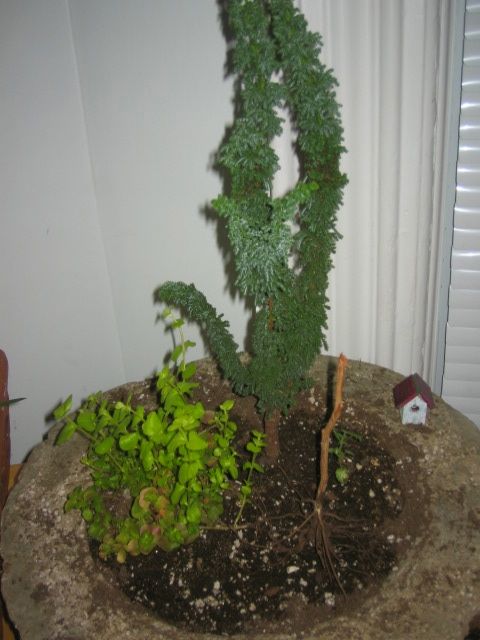
This trough contains two plants I propagated: Upper right, Euonymous fortunei;
Center: 'Ascot Rainbow' Cushion Spurge Euphorbia.

During this stretch of a few months I successfully propagated (to name a few): Abutilon (Flowering Maple),  Podocarpus macrophyllus ("Japanese Yew"), 'Ascot Rainbow' Cushion Spurge Euphorbia, Euonymous fortunei, and numerous sedums (much more on Sedums is to be forthcoming). Many of my  experiments failed. It's okay. There was enough success to render bliss.

Garden Lesson: There is an advantage (on one level) to not knowing the scientific way to go about such things as propagation. I have benefitted from not knowing what I was doing because I was unafraid to try anything, even if is was deemed unconventional. Plants love to grow!

Life Lesson: Starting a new life from a severed and prematurely uprooted one requires patience, diligence, watch care, warmth, refreshment and a willingness to believe that growth is happening, even if you don't see it.

Go here to read "First Steps," then follow on through to "Second Steps"

Tuesday, October 16, 2012

Growing Tiny Gardens: Second Steps

We quickly realized that, as a small growing business, it's all about getting out there. (Aspiration.)

Garden Lesson: Once we had put a dent in our inventory (read: up to our ears in hypertufa), we knew we had to understand "the market" and how to cobble together a "plan." We made a good effort by attending the New England Grows! conference in Boston last February.


Wow. I say it again. Wow. New England Grows! 2012

Wow -- and I mean that in an overwhelmed kind of way.  Life Lesson: One of the benefits of getting out there is coming to realize what, truth be told, isn't your strong suit. What isn't mine,  I learned, is trying to navigate conference-center space with 1000s of vendors and little idea what I was looking for.

Chamaecyparis obtusa
'Chirimen'
Good news! The highlight of my day was discovering the booth of Iseli Nurseries and having the chance to buy my first miniature conifers from them, right off the floor. I was especially thrilled to take home a new cultivar that has just recently entered the trade: Chamaecyparis obtusa 'Chirimen'. (Pronounced cammy-SIP-ahr-us --get used to it.) I love this little tree! It reminds me of the elegant commanding Cypress trees that adorn the landscape of Umbria, Italy, which I beheld daily during my years living there.

This little evergreen (hardy to Zone 5) "displays multiple textures and colors, which explains the Japanese name, 'Chirimen' a dyed crepe silk fabric." (Direct quote from GardenWeb.) The upright growing habit becomes a cluster of thick, vertical shoots with tightly congested blue and green foliage.

You'll be hearing much more about this cultivar. Later in the season I bought ten of them.

Go here to read third steps.

Friday, October 12, 2012

Why Miniature Gardening?

A Large Conifer World
A Miniature Conifer World 


Is it hokey? Is it like playing dolls? Or with army men? I tell people I like miniature gardens because at least on one level -- these small, magical worlds are something I can control (as opposed to the massive huge, immeasurably fast and unstable big world in which we live).  It takes great patience to work in a small scale and steadiness of hands. Good eyes help, but magnifying apparatus can save the day.

Plants, especially, carry their own magic in miniature. One man once said to me, "If you can't eat it, why grow it? We don't need pretty. We need edible." I said, "Have you seen what I am growing?" He said (of course), "No.  I don't need to see it." I said, "Can you see that pine tree over there?"-- pointing to an Eastern Red Cedar about 50 feet tall. He said he did. I said, "I grow those, only six inches tall. Don't you think that's worth looking at?"

He didn't answer. Which, I think, is a good thing.

Aspiration: Joy in creating small living worlds.

Garden Lesson Learned: Growing in miniature can be easily managed on one level but demands vigilance on another level. Small plants in small containers need watered more regularly and will respond to adverse growing conditions in a more accelerated fashion. That said, once the stress factor is remedied, small plants in containers also rebound faster. Always keep sharp snips at the ready. These little friends will be gratified with regular grooming.

Life Lesson Learned: Gardening in miniature creates an aptitude of patience with an element of whimsy. People might not take you seriously until you show them the true scale of things and do so with a glint in your eye.


Thursday, October 11, 2012

Growing Tiny Gardens: First Steps


A year ago, my friend Heather and I began making troughs. We knew what we were doing only insofar as knowing how to mix the needed ingredients (cement, peat and perlite). Beyond that it was an anything-goes proposition. We tried molds; we played with shapes and sizes; we experimented. Rain or shine.

Aspiration: Start somewhere -- build inventory.


Garden Lesson Learned: Making trough gardens takes time and involves a lot of combinations. The first time element is the making, curing, and leaching of the trough, which you've made with the proper balance of the three ingredients noted above. The second time element involves thinking through plant choices, learning their habits and light & soil needs, and then finding (or propagating) the plants. The third time element occurs after the previous two steps have been realized and you've introduced plants to your trough. The waiting and watching begins.


Life Lesson Learned:  Try anything. You'll be amazed at what works (and what doesn't).  Be patient: anything this good and long-lasting is going to take time. Watch your troughs as you watch your life: watch for evidence of stress and look for answers on the internet.

To view "Second Steps go here.